Pattern Imprinted Concrete Driveways Leicester
04/11/2026

Water sitting across a driveway after a Leicester downpour is more than an inconvenience. It can make paving slippery, stain surfaces, wash out jointing material and slowly undermine the foundations beneath. Knowing how to fix driveway drainage problems starts with identifying where the water is coming from, where it should be directed and whether the existing surface has been installed with the right levels.
A lasting repair is rarely achieved by simply filling the lowest puddle. Good driveway drainage needs a considered combination of falls, a stable sub-base, suitable drainage channels and, where appropriate, a permeable surface. The right answer depends on your driveway’s size, material, slope, soil and the position of your home, garage and garden.
The visible puddle is not always the source of the issue. Water can collect because the driveway has settled over time, but it may also be travelling down a slope from the road, overflowing from gutters or being trapped against a raised threshold.
Walk the driveway during or shortly after rainfall. Look for the route water takes rather than focusing only on the final pool. This provides a much clearer picture of whether the issue is surface water, roof water or poor ground drainage.
Common signs that a driveway needs attention include:
A professional survey should also check the levels at the pavement, property and any existing drainage points. A driveway can look flat to the eye while having enough of a dip or reverse fall to cause regular flooding.
For many properties, the proper solution is to regrade part or all of the driveway. This means lifting the existing surface where possible, reshaping the sub-base and reinstating the paving so water moves in a controlled direction.
Driveways should normally fall away from the building. The exact gradient depends on the surface and site conditions, but it must be sufficient to prevent water lingering while remaining comfortable and safe for vehicles and pedestrians. A fall that is too slight will not shift water effectively. One that is too steep can make a driveway awkward to use and may send run-off too quickly towards a boundary or pavement.
On block paving, localised sinking can sometimes be repaired by lifting the affected blocks, rebuilding the bedding layer and compacting the base beneath. This is cost-effective when the problem is limited to a small area and the wider sub-base remains sound.
If several areas have sunk, or water is consistently moving towards the property, patch repairs may only delay the problem. Reconstructing the driveway base and setting new levels is the more dependable option. It also creates the opportunity to install drainage correctly rather than trying to add it after the event.
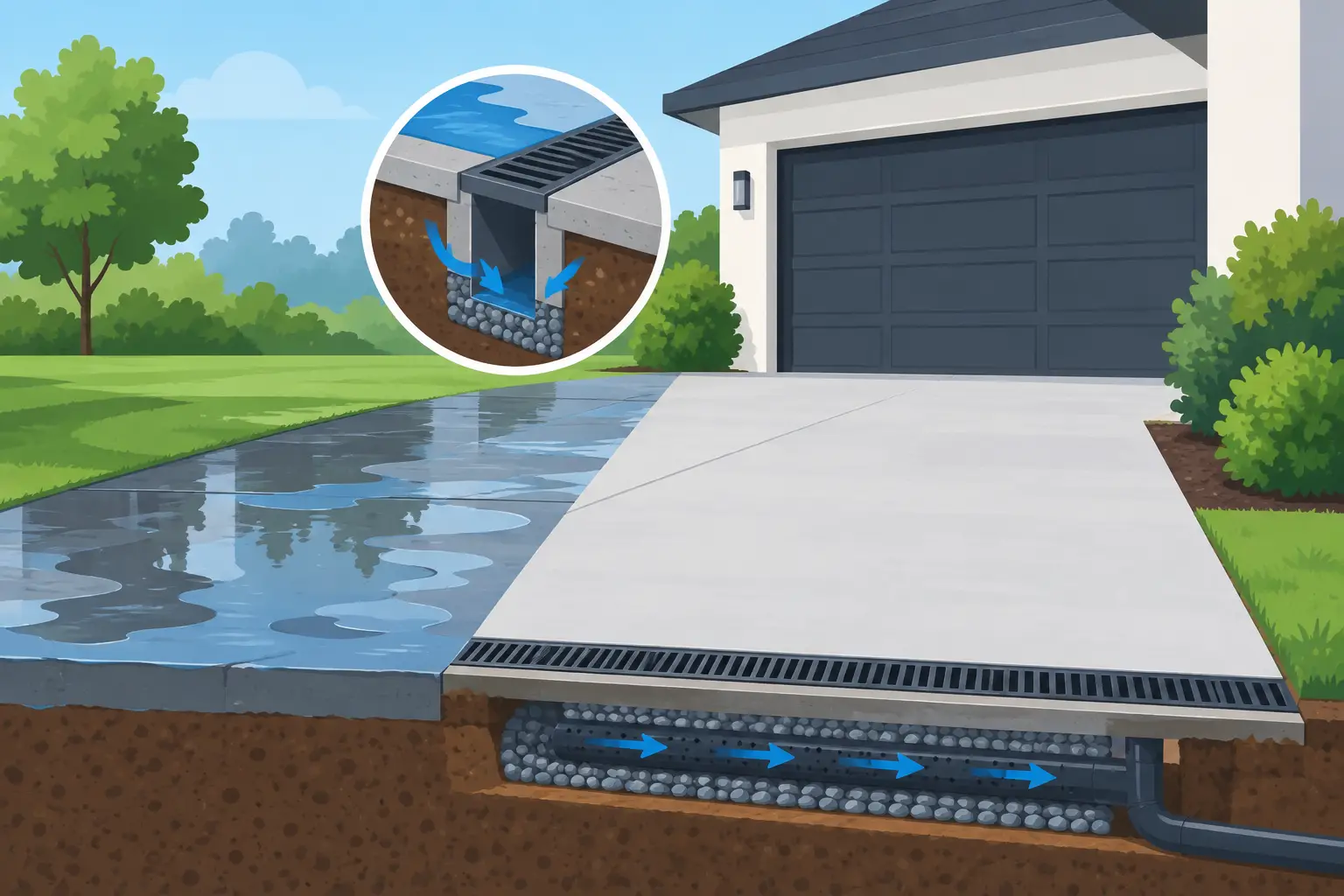
A linear channel drain is often the best way to intercept water before it reaches a garage, front door or lower section of paving. It consists of a narrow grated channel set into the driveway, usually along the front of the property or across the base of a slope.
The channel collects surface water and directs it to a suitable outlet, such as a soakaway or another approved on-site drainage arrangement. Grates are available in practical galvanised finishes as well as options designed to blend more neatly with block paving, resin or natural stone.
Positioning matters. A channel drain placed directly outside a garage can protect the threshold, but it will not solve a wider drainage problem if the rest of the driveway still directs water towards neighbouring land or the public highway. The surrounding paving needs to be formed with clean, consistent falls into the channel.
These drains also need occasional maintenance. Leaves, grit and moss can restrict the outlet, particularly beneath trees. Clearing the grate and checking the channel after autumn leaf fall helps it continue working as intended.
Where ground conditions allow, a soakaway provides a practical destination for collected rainwater. It is an underground structure, generally filled with purpose-made crates or clean stone, that allows water to disperse gradually into the surrounding soil.
A soakaway must be sized for the amount of water it will receive and positioned carefully away from buildings and boundaries. Heavy clay soils, common in parts of the Midlands, may drain slowly and can make a small soakaway ineffective. In those conditions, the design may need a larger capacity, alternative drainage measures or a more comprehensive assessment of the site.
Surface water from a new or replacement driveway should generally be managed within the property rather than discharged onto the road or public drainage system. Requirements can vary according to the work and location, so drainage should be considered at the design stage, not once the surface is already laid.
Permeable construction allows rainwater to pass through the surface and into the layers below, reducing visible run-off. It is particularly useful for front gardens being converted into parking areas or for properties where conventional drainage outlets are limited.
Permeable block paving uses specially designed blocks and wider joints filled with graded aggregate. Water enters through those joints, passes into an open-graded sub-base and either soaks into the ground or is stored temporarily before draining away. It can provide a traditional, detailed driveway appearance while offering effective water management.
Resin bound surfacing can also be permeable when installed over a suitable porous base. It creates a smooth, attractive finish with no loose stones, but its drainage performance depends entirely on what sits beneath it. Applying resin bound material over an impermeable or failing base will not resolve standing water.
Gravel is naturally free-draining, although it needs proper edging, a stable foundation and regular raking to keep it tidy. Standard tarmac and imprinted concrete are generally impermeable, so they require well-planned falls and drainage channels. There is no single best material for every driveway. The most suitable choice balances appearance, traffic levels, maintenance expectations and the ground conditions beneath your property.
Overflowing gutters and downpipes frequently add to driveway flooding. If a downpipe discharges at the edge of the paving, it can erode the driveway base, stain the surface and create a concentrated wet area even when the driveway itself has good levels.
Direct roof water into an appropriate drain, soakaway or water butt system rather than allowing it to spill across the driveway. If a downpipe connects into a channel drain, the system must have enough capacity for both roof run-off and surface water during heavy rainfall.
This is particularly relevant when improving a full frontage. A new driveway, patio, path and lawn can alter how rainwater moves around the property, so each element should work as part of one drainage plan.
It is tempting to seal cracks, add a bag of sand to low paving or lay a thin overlay of tarmac. These measures can improve appearance temporarily, but they do not correct a weak sub-base, trapped water or unsuitable levels.
Professional reconstruction is usually worth considering when water is entering the property, the driveway has widespread movement, drainage is absent or the surface has reached the end of its serviceable life. Rebuilding from the ground up allows for excavation, a properly compacted foundation, suitable edging, correct gradients and integrated drainage. The result is not only more reliable in wet weather but also safer underfoot and more attractive from the street.
For homeowners and businesses across Leicester and the surrounding Midlands, Leicester Driveway can assess the cause of recurring standing water and recommend a tailored solution, from localised paving repairs to a fully redesigned, drained driveway. Request a quote before the next period of heavy rain turns a manageable surface issue into damage to your paving or property.
A well-drained driveway should do its job quietly: rain falls, water moves where it should, and your entrance remains clean, stable and ready to use.